
A full stop at the end of a text message reads as neutral punctuation to most people over thirty. To many Gen Z employees, the same full stop can be read as clipped or even irritated. Both groups are looking at the same thing but neither one realises they’re reading them through a completely different lens.
This kind of small misreading happens constantly in most workplaces, and it rarely gets noticed until it adds up to something bigger: a colleague who seems distant or a team who responds badly to messages their manager feels are well calibrated. None of this is really about punctuation, emojis, or slang. It’s about generational communication habits that were shaped by different technology and different formative years, all now sitting side by side in the same Slack channel.
Generational diversity at work isn’t a future shift to prepare for. It’s already the daily reality of most teams. Millennials became the largest generation in the UK workforce in 2019, overtaking Baby Boomers, and Gen Z has grown quickly enough that it now makes up more than one in five workers in the UK, according to research cited by workplace consultancy Amba. Depending on the sector, some teams also include the earliest Gen Alpha entrants alongside a small but present number of Traditionalists, meaning up to five generations can realistically be working alongside each other at once.
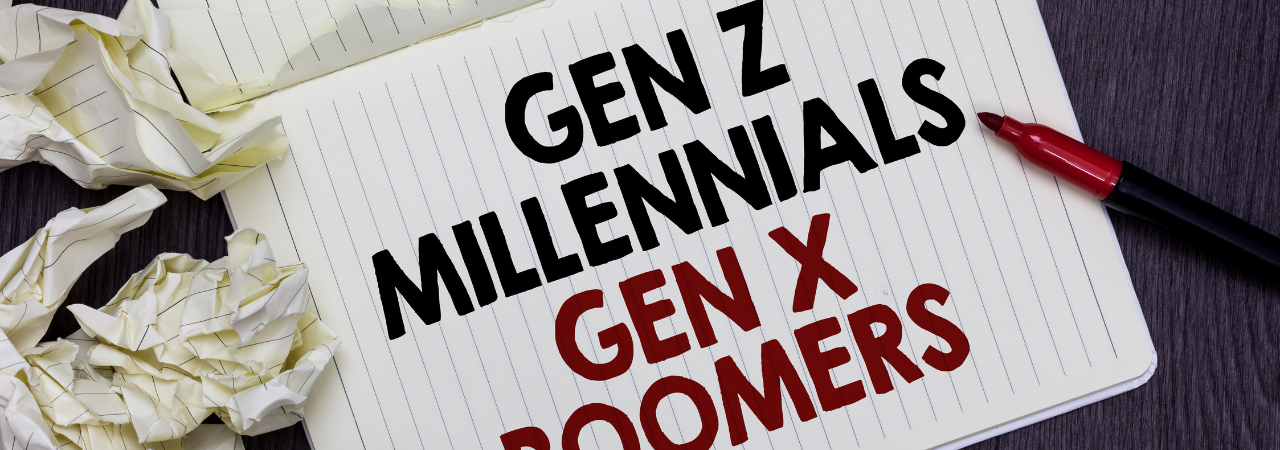
It’s worth being precise about what these labels actually cover, since the boundaries are wider than they often get assumed to be. Gen Z isn’t just teenagers. As of 2026, the oldest members of Gen Z are approaching thirty, while the youngest are still at school, which means the label spans school leavers and established professionals several years into their careers. The generations most commonly referenced in the workplace follow the age ranges of Baby Boomers (born 1946 to 1964), Gen X (1965 to 1980), Millennials (1981 to 1996), and Gen Z (1997 to 2012).
Each of these groups built their communication habits during the technology and culture of their formative years, and each brings something genuinely useful to a team: different perspectives, different instincts, different ways of solving the same problem. But that same range is also where the friction comes from. People don’t just communicate differently. They expect different things from a message, and they read different things into one.
Most people are aware, in a general sense, that generations communicate differently. Fewer have thought about where those differences actually come from, or how they show up in an ordinary Tuesday afternoon message.
Channel preference is one of the clearest examples. Research from Barclays LifeSkills found that 49% of Gen Z employees choose instant messaging over email at work, and a 2024 Uswitch survey found that 70% of 18- to 34-year-olds prefer texting to phone calls, with a quarter saying they never answer a call at all. For someone who came up through a working world built on email threads and scheduled calls, that shift can look like a lack of professionalism. For the person sending the text, it’s simply the most natural and efficient way to communicate.
Punctuation and message length carry a similar mismatch. A short reply, a full stop, or a lack of capital letters can read as clear and direct to one colleague and cold or dismissive to another, even though neither meaning was intended. Emojis follow the same pattern in reverse. An Atlassian survey found that 88% of Gen Z employees think emojis are useful at work, while fewer than half of Gen X and Baby Boomer colleagues feel the same, with many unsure what a given emoji is even meant to convey. A thumbs-up can feel like a warm, efficient acknowledgment to one person and a passive-aggressive brush-off to the next.
Informal language adds another layer. Terms like “slay,” “no cap,” or “tea” are everyday vocabulary for younger employees and genuinely unfamiliar to colleagues from other generations, which can create a sense of distance that was never intended in the first place.
None of these habits are wrong. They’re just different defaults, each one shaped by a different set of tools and norms.
Even when you’re aware of the differences, connecting that awareness to the specific moment it actually shows up can be hard. If a thumbs up would make you feel validated, realising that’s the reason your co-worker thinks you dismissed their idea is difficult. Left unaddressed, these small misreadings don’t stay small. They accumulate into assumptions about a colleague’s attitude, their professionalism, or how easy they are to work with, and those assumptions are far harder to shift once they’ve settled in than the original message ever was.
The costs that follow are harder to measure than an absence figure, but they’re real all the same: slower collaboration, more guarded communication, less willingness to raise a concern early, quieter teams where people disengage rather than risk being misread again.
Before going any further, it’s important to be clear that no generation’s communication style is more professional, more respectful, or more correct than another’s. Each one developed for real reasons, shaped by the technology, culture, and expectations of that generation’s formative years. Our grandmothers, or great great grandmothers, would have been shocked by women working after marriage. Workplaces change and accepting those changes is the starting point for working with them
The business impact of generational miscommunication rarely shows up as a single dramatic failure or huge argument, but gradually, in ways that are easy to miss. Quieter team members, particularly those already less confident, tend to disengage rather than risk being misread, which slowly narrows the range of voices a team actually hears from. Knowledge transfer suffers too. Older employees hold institutional knowledge, and younger employees bring digital fluency, but if communication friction gets in the way, that exchange stops happening naturally in either direction.
Research cited by Harvard Business Review found that 76% of employees believe generational communication gaps slow down work, and separate research from LinkedIn found that 89% of HR professionals see this as a significant workplace challenge. Talent retention takes a quiet hit as well, since the discomfort of feeling consistently misread is rarely the stated reason someone leaves a role, even when it’s part of the real one.
Some of the friction between generations isn’t just about communication style. It shows up in things like expectations around work hours, where Baby Boomers may expect traditional office hours and Millennials may push for flexibility, or in decision-making, where Gen X employees may want autonomy that clashes with a Baby Boomer preference for a more hierarchical process. None of these are communication problems in the narrow sense, but they shape how generations interpret each other’s messages day to day, so they’re worth addressing alongside the more obvious habits like tone or emoji use.
Working alongside colleagues from a different generation tends to do more to break down assumptions than any guidance document, simply because it replaces a stereotype with an actual person. This is a growing area of focus across the HR profession too, with CIPD running dedicated events exploring how organisations can bring generations together and build a culture-first approach to collaboration across the workforce. A team doesn’t need a formal event to borrow the underlying idea. Structuring project teams to mix generations, creating space for older employees to mentor younger ones, and building in regular opportunities for cross-generational knowledge sharing all move in the same direction.
Understanding how an individual or team actually prefers to communicate takes more than a single survey. Pulse surveys offer a quicker, more frequent way to surface preferences and friction points than an annual review can, and used well; they give HR a much earlier signal that a communication problem is forming before it shows up anywhere more visible.
The easiest way for people who communicate differently to understand each other is, quite simply, to talk to each other about it. That’s a difficult thing to do for obvious reasons, but if your team can feel secure in saying “I know that it wasn’t your intention but when you do x it makes me feel y” or “I know you think I’m an old codger but I just don’t check my phone during the day, would you mind using email or slack if you’re sending an important message” then what starts as a real communication mismatch can become an honest conversation which helps them understand each other better.
Offering different working arrangements, whether that’s flexible hours, hybrid schedules, or simply more choice over internal communications platforms, accommodates generational differences in expectation without asking any one group to simply fall in line with another’s preference.
None of this is really about full stops, emojis, or incomprehensible slang. It’s about how easily a habit gets mistaken for an intention, especially when nobody’s ever named the gap out loud. A short message doesn’t mean someone’s upset. A missing reaction doesn’t mean someone’s checked out. Most of the time, it just means two people learned to communicate in different worlds.
That’s worth remembering the next time someone accidentally offends someone else. A little curiosity, offered before judgement, tends to close more distance than it costs. Understanding where a colleague is coming from changes more than how a message lands. It changes whether people feel safe enough to keep speaking up at all.